Pale colors create emotion [Angénieux Retrofocus R2]
「湖楼」korou A1 28mm f2.2
2025.11.12
Wide-angle lens with a huge front lens element
The following explanation is found in "The History of the Photographic Lens."
Since the early 20th century, when projecting magic lantern slides, a "magnifying lens" has been used to enlarge the image on the screen. This is a large concave element placed in front of the front focal point of the projection lens. This element shortens the focal length of the entire lens, enlarging the projected image. This is the exact opposite of a concave element placed behind a normal lens to extend its focal length. - "The History of the Photographic Lens," Chapter 10, "Inverted Telephoto Lens," by Kingslake
Since the principle is similar to that of a magnifying glass, it was likely understood from the early days of optics. A full-scale design was first developed in 1929 for close-up widescreen projection, and a larger one was designed by Lee of Taylor-Bobson in 1931. Mass production began before the war, initially for 8mm cameras, and is said to have involved extremely complex structures using multiple elements, even aspherical surfaces (hand-polished). Then, with the emergence of SLR cameras in the 1950s, reverse telephoto lenses were once again produced due to their long back focal lengths. One such lens was the Retrofocus by Angénieux of Paris. This product name became the generic name for all reverse telephoto lenses (including those made by other companies). However, an old French patent from Angénieux uses the term "Grand Angulaire," which is the same as the German term Super Angulon.
There are several types of Retrofocus from Angenieux. The following have patent data:
- R1 35mm f2.5
- R2 35mm f2.2(The actual models produced were 18.5mm and 24mm for 35mm movies.)
- R11 28mm f3.5
- R61 15mm f1.3(For 16mm movies. Equivalent to 50mm on 35mm film.)
- R61 24mm f3.5(ALPA)
The R1 is highly acclaimed worldwide and is considered Angenieux's masterpiece. In addition to the R1,
ALPA also chose the R11 and R61. The retrofocus lenses found without patent data are as follows:
- R21 10mm f1.8(For 16mm movies)
- R31 6.5mm f1.8(For 8mm movies)
- R4 12.5mm f2.2(For 16mm movies)
- R41 15mm f1.3(For 8mm movies)
- R62 14.5mm f3.5(For 35mm movies)
The patent R1 was first applied for in France, and R2, which was submitted later, was approved first. The application date was July 5, 1950 (French Patent
FR60430). This is a film lens supplied with an Arriflex mount. Angenieux types are assigned a number following an alphabet indicating the lens configuration, with the difference in the amount of aberration: 1 is for still photography, 2 is for cinema, and 3 is in between, but the use is not limited to that. 4 and above are modern designs. The second digit of the number indicates a variant, and it seems that there are only two types: 1 and 2.
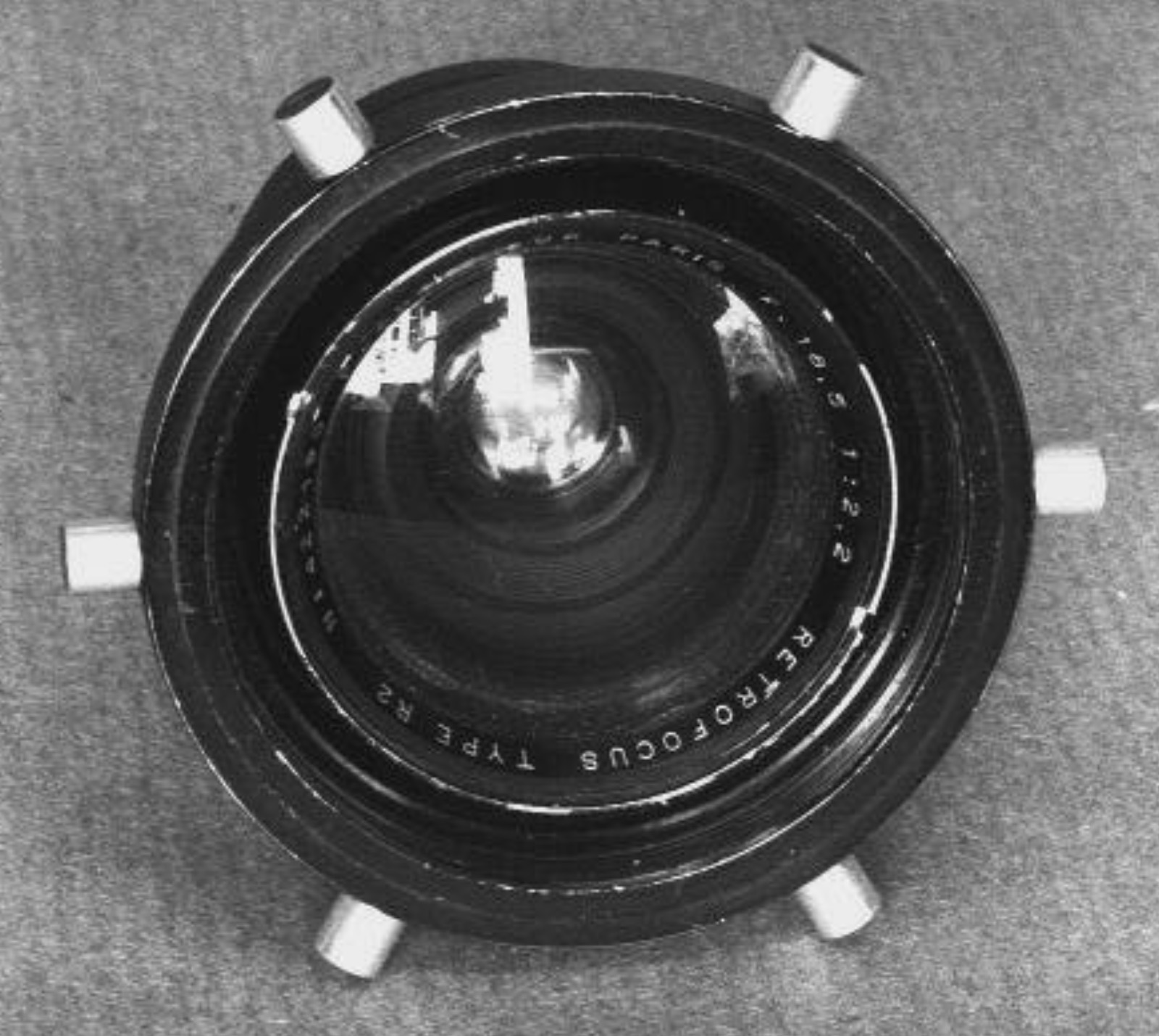
Until around the 1950s, the concept of motion picture ("Kino" Germany) aberration was emphasized, but with the emergence of inexpensive Japanese-made cameras, performance became the norm. Performance became more important than image quality. So, what we're looking for is the Angenieux, which is number 2, but it's designed for small film and uses small glass, so it doesn't seem to bring out its true potential. The Dagor was also eventually shortened to 40mm, but it feels like it's lost its distinctive character, and when you see something like this, you still need a certain amount of glass mass. The
Rapid Plasmat is an 8mm lens, so it becomes huge when enlarged to Leica format, but the image quality is correspondingly richer.
The reason there are so few wide-angle Kino lenses may be related to the fact that it wasn't long after Angenieux adopted the retrofocus system, which finally allowed for a wider angle of view, that Japanese-made cameras began to flood the market. For this reason, the Angenieux R2 is an exceptional wide-angle Kino. We hope that it will be manufactured in the Leica format, which will give it a sense of sufficient mass.
The R2 was actually produced in 18.5mm and 24mm f/2.2 versions. In Leica format, these were equivalent to 28mm and 35mm. The angle of view was 76 degrees (blue light) at a focal length of 28mm and 64 degrees at 35mm. Looking at the patent, the angle of view recommended by Angenieux is 65 degrees (green light, the position indicated by the line on the aberration diagram).

 Dedicated hood included. Filter diameter ?mm. Minimum shooting distance ?m. Aperture blades ?. Actual weight ?g.
If you change to 35mm, you get the image below. This is the recommended angle of view indicated in the patent, but if you go from there to a 28mm lens, the glass gets smaller and scales down, so the amount of aberration remains almost the same. For that reason, it was sold without any problems at the 28mm equivalent. However, it seems difficult to widen the angle of view any further. While it is mathematically possible to make it a 50mm standard lens, the front element would be huge, so there seems to be no point in adopting it. Already at 35mm, the viewfinder would be significantly vignetted due to its size, making it impossible to use a rangefinder on a Leica, and it would also be difficult to place the camera.
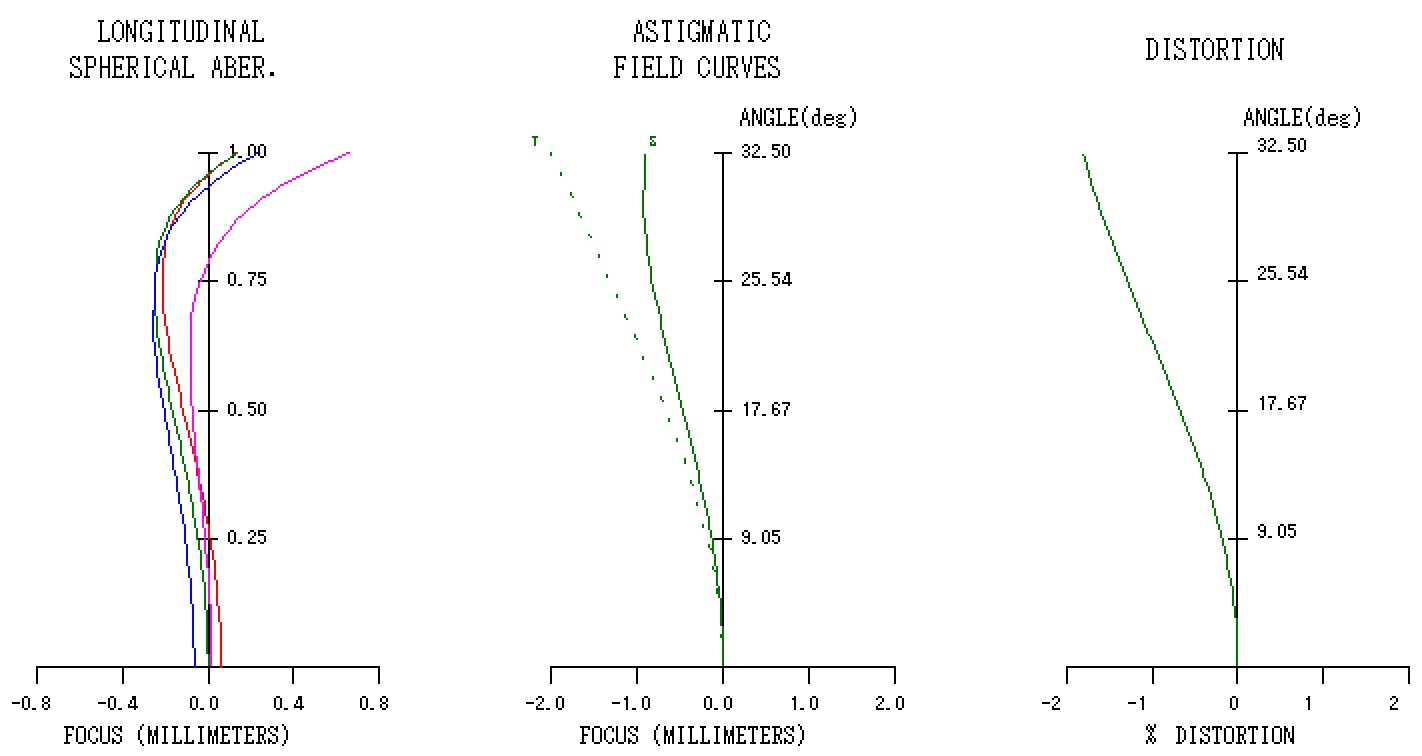
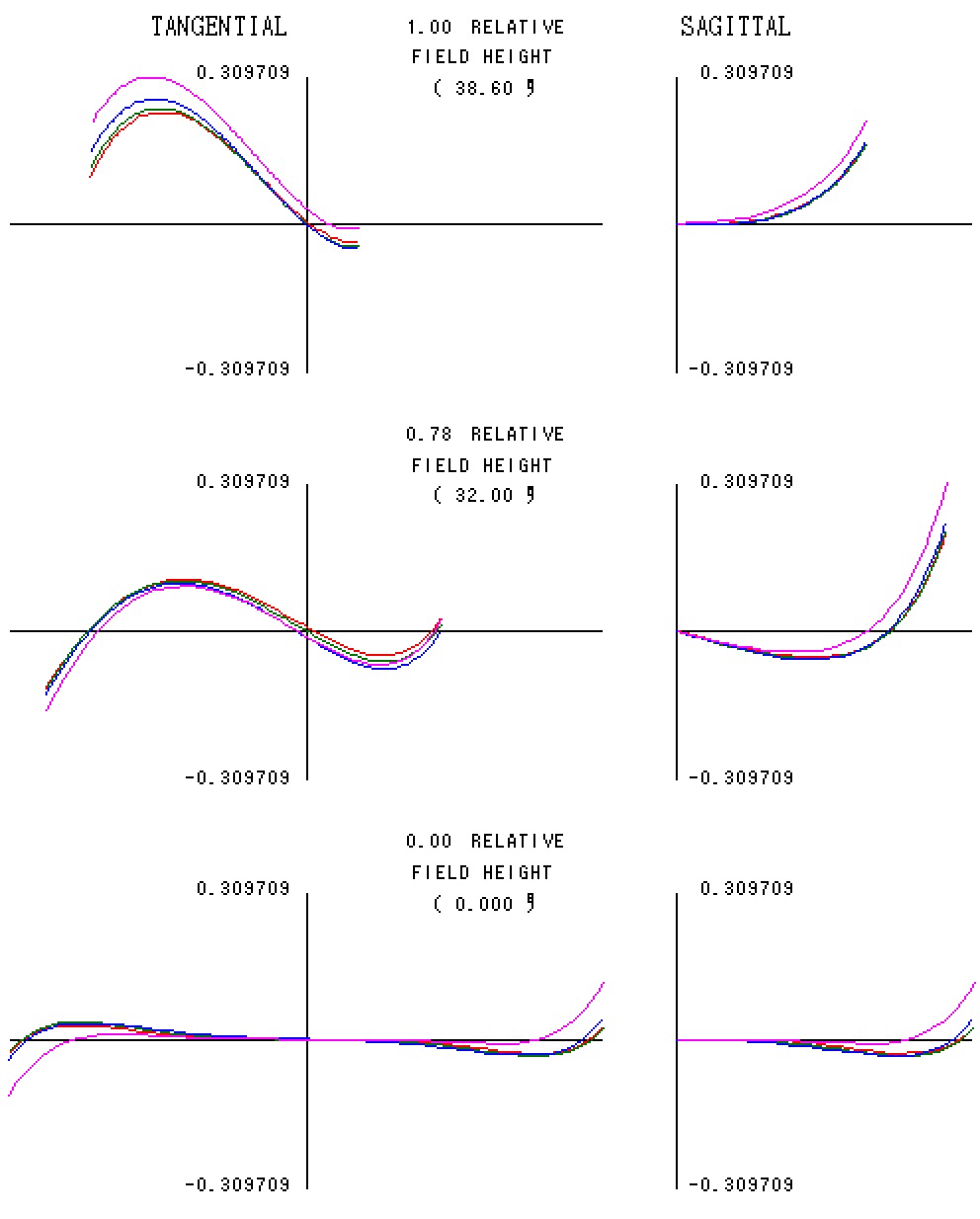
This is a diagram of lateral aberration at a focal length of 28mm. The spatial distortion that is typical of Kino lenses is unlikely to be present. Because it is a wide-angle lens, it is not intended for close-ups of subjects, but on the other hand, it is not acceptable to have no aberrations when shooting moving video, so it includes a larger amount of aberration than the R1 or R11. This subtlety is a characteristic of wide-angle Kino lenses. Therefore, it is not a type that is difficult to master.
Since this is a Kino lens, the depth of field seems quite large, but it's unclear. If we calculate using the standard depth of field, at f/2.2 aperture and a distance of 12m, it goes from infinity to 6m. At a distance of 5m, the depth is 3.5-8.6m. In reality, it's likely even larger. Therefore, there's no need for Leica rangefinder coupling, making this lens much cheaper to produce.
When the viewfinder is mounted on a Leica, it is so large that you can see the lens at the bottom of the field of view. It is the same size as the
P3. Therefore, we considered making the focal length 25mm, but unless we enlarged the front lens, the corners would be dark and the aberrations would not be beautiful. There is a limit to the size. Common sense would dictate that this would be impossible to commercialize, but like the P3, there is no other lens like this, so we had to produce it.
Angenieux's repertoire of classic 35mm cinema lenses is as follows:
The calculated image circle of R2 18.5mm is 28.5mm, and that of R2 24mm is 37mm. Since the Leica format is 43mm, the focal length was set to 28mm.
- R62 14.5mm f3.5
- R2 18.5mm f2.2
- R2 24mm f2.2
- S2 28mm f1.8
- S2 32mm f1.8
- S2 40mm f1.8
- S2 50mm f1.8
- M1 50mm f0.95(NASA)
- S3 75mm f1.8
- S3 100mm f2.0
The R1 35mm f2.5 was applied for on February 17, 1950, which was the earliest, but the approval process was slow. (French Patent
FR1013652)


Next was the R11 28mm f3.5. June 29, 1952.(French Patent
FR62932)


The next one is the R61 15mm f1.3, which was released on May 6, 1957, so it's been a while. (French Patent
FR1189915). This was the year that Pentax released its first SLR camera. This was for 16mm film, so the focal length is equivalent to 50mm in 35mm format.


Standard 50mm has data for M1 (
Angénieux S1「湖楼」A2 50mm f1.8). When comparing the same focal length and aperture, they are quite close. Therefore, it was concluded that this was the layout for standard cine lenses.

Next was the R61 24mm f3.5. September 23, 1957 (French Patent
FR1192221). As the 1960s approached, the trend became more clearly right-handed. This was a similar trend in Germany. Data was also released showing that this had been improved a year later.


It's the same R61 24mm f3.5. It was on October 9, 1958 (French Patent
FR1214945). It seems like they intentionally increased the aberration. And to achieve that, they added another piece of glass. I think they wanted a bokeh like the R2. This is the design that was supplied to the Alpa.


There are also triplets available as reference data (
Angénieux Z「湖楼」A4 50mm f3.5). It seems that this was the standard for classic Angenieux.
 Back
Back
 Since 2012 Photo Cinema reproduct lens [Mu-Yichi-Kyo] is licensed under a Creative Commons 表示 4.0 日本 License.

